
A KATANA BY MIYAMOTO KANENORI 

This is a fine katana by the Jo-saku rated smith, Kanenori. He was born in Hoki (Tottori Pref) in 1830 and aspired to become a sword smith from an early age. He entered the mon of Bizen Yokoyama Sukekane when he was 22 years old. After studying for seven years, he returned to Tottori Prefecture and became a swordsmith for the Tottori Daimyo. In 1863 he moved to Kyoto and in 1866 he made swords for the Emperor Komei. He ws given the title "Noto no Kami". After the Boshin War, he made some swords for the Emperor Meiji. In 1866 he moved to Tokyo and made a sword to dedicate to the Ise Jingu Shrine. He continued to make many swords for the Imperial family and together with Gassan Sadakazu he was appointed Teishitsu Gigei-in. He passed away in 1926 at age 97.

His works can be seen from the Ansei Era and this sword is dated in the fifth year of Ansei or 1858). Interestingly enough, most reference books list his oldest swords as being from the Bunkyu Era or 1861. Since this sword predates that idea, this is one of the earliest signed examples by this smith making this sword a precious example of his early work. Also since we know that he died in 1926 at the age of 97 years, we can calculate that he made this sword when he was 29 years old.

Even though his works become scarcer after the edict abolishing the wearing of swords, he had a long working life spanning some 60 years. Many of his later works have his age added to the nakago.

This katana is typical of his work. The cutting edge is 69 cm or 27 1/8 inches. The mihaba is graceful with a moderate koshi zori. The hamon is gunome midare with clusters of two to three choji within the gunome. The hada is a tight itame but not as tight as found in later Shinshinto works. It is quite beautiful. The boshi is o-maru turning back in a long kaeri. There is a lot of nie along the habuchi making this a quite active temper line.

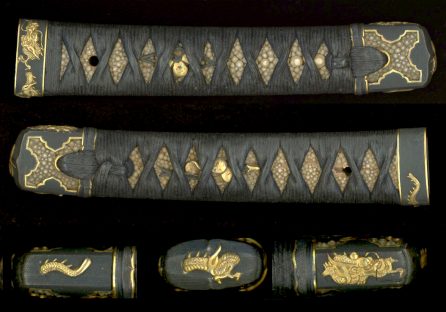
This sword also comes with a nice koshirae, probably the original one for this sword. It is certainly the kind of koshirae that I like to find with a sword as it is obvious that this is a koshirae that was worn day to day by the Samurai owning this sword. Too often we find "put together" koshirae with no history. You can feel the power and history of this koshirae.

The style of this koshirae is a handachi koshirae. All of the metal parts, except the menuki, are made of iron and all, including the tsuba, are of carved cherry blossoms in the Bushu school style which makes sense if the smith was working in Tokyo. The menuki are shakudo and gold of Mio temple guardians.

The sword comes with NBTHK Hozon papers attesting to the quality and authenticity of the blade and the signature. This blade just came from Japan where getting only Hozon papers to verify authenticity is normal.

PRICE: $ 13,900.00


Questions or feedback? Email me!

hageyama@mindspring.com